
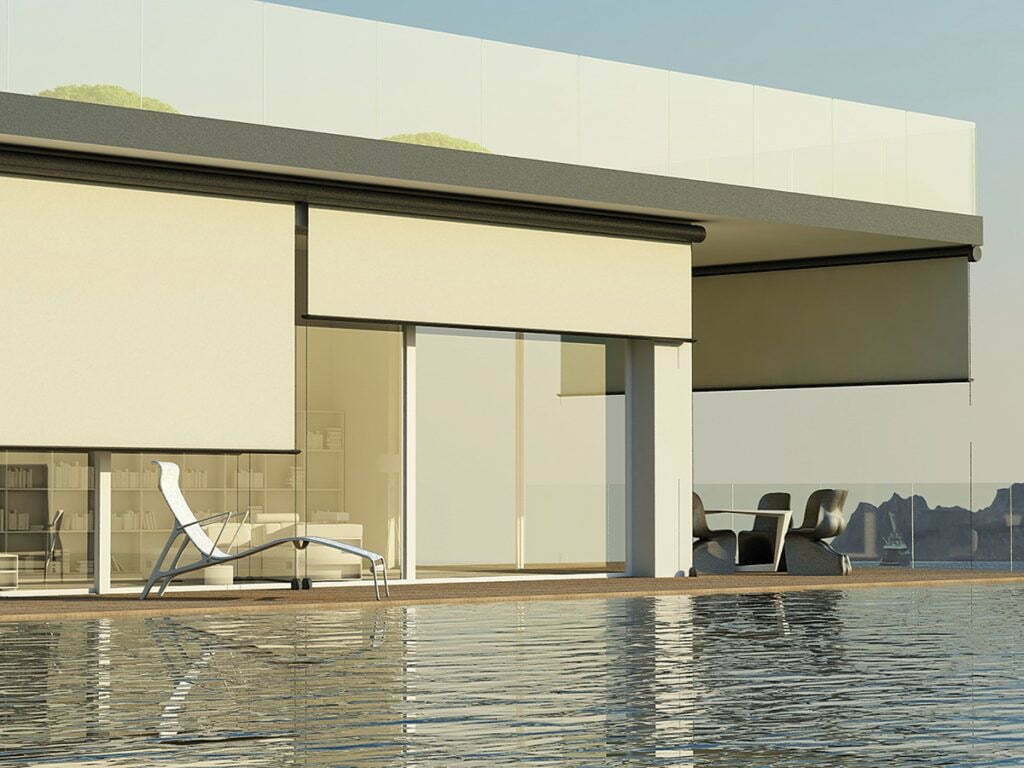
In October we covered perimeter protection for your veranda: how a vertical system closes off the open sides and keeps out wind, rain and cold. The two main categories used for this are fabric vertical screens and glass panels. Here are the features and benefits of each, to help you decide what fits your own space this winter.

Vertical Screens: Flexible Fabric and Opening Options
The range of vertical roller screens offers a lot of flexibility, especially in the fabric you choose. Acrylic fabric gives full shade and privacy. Perforated fabric lets air and light through while keeping your privacy, without fully closing off the view toward the garden or the street. And clear PVC-type fabric keeps your visual connection to your surroundings almost as if there were no screen at all, while still protecting against rain, wind and damp. It is particularly popular in winter, precisely because it lets you use your veranda like an enclosed room without feeling visually shut in.
The guide mechanism also makes a difference, both in how the system looks and in how the fabric holds. Aluminium side guides are the most classic option. Cables or rods give a slimmer, more discreet line that suits more modern façades. And a zip guide keeps the fabric held firmly along both edges for its full length. Which one fits your own space depends on its height and layout, and on the look you are going for. Ask us about it before you decide.
The advantage of vertical screens is flexibility: they raise and lower gradually, depending on the weather and the moment, and cover a wide range of needs, from light shading to a full close.

Glass Panels: The Most Complete Solution
For anyone who wants maximum protection, there are also glass panels, available in more than one configuration: stacking panels, up and down panels, or triple motion systems, depending on your space's dimensions and use. Glass, being a rigid material, blocks wind and rain more completely than fabric once it is fully closed, and gives the space a more premium, permanent feel.
This option typically comes at a higher cost, and becomes a fixed part of the space from the moment it is installed, since it cannot be fully retracted. A vertical screen, by contrast, is a much lighter construction made mainly of fabric, which can retract completely and has a more discreet appearance when not in use. In exchange, glass offers a more stable, permanent feel for anyone who wants their space closed off almost like an indoor room.
Which One Fits Your Space
Check your veranda's height and layout: every space has its own conditions, and these determine which vertical system and which guide mechanism fits best. Ask us about the type of vertical system that fits your space.
Think about how often you will use it in winter: for daily use as an enclosed sitting area, a vertical screen with transparent fabric combines the view and the protection.
Decide how much flexibility matters: a vertical screen raises and lowers gradually and can retract completely out of the way, while glass panels offer a more stable, permanent solution.
Factor in your budget: vertical screens cover a wider cost range, while glass panels offer the most complete solution at a higher cost.
Every veranda has its own exposure, orientation and pattern of use, and there is no single answer that fits them all. If you would like us to take a look and tell you which system makes sense for your own space, we are happy to come by and walk you through the options.
Want to learn more?
Since 1974, we've designed and built custom shading solutions. Contact us for a free assessment.
Request a Quote