
Ask five different companies for a price on "a pergola awning" and you can easily get five very different numbers. That's not because anyone is overcharging — it's because the price of a shading system depends on a long list of specific choices, and "a pergola awning" can mean a dozen different products. Before you request a quote, it helps to understand exactly what you're paying for. Here's a complete, honest breakdown of what drives the cost of an awning, pergola, or bioclimatic pergola up or down.
The Short Answer: What Determines Your Price
Every shading system quote comes down to the same handful of variables. In rough order of impact, they are:
- Size and coverage area — more square meters means more material, more structure, and more labor.
- The type of system — a fixed awning, a retractable awning, a pergola awning, or a bioclimatic pergola sit at very different price tiers.
- Manual vs. motorized operation — motors, remote controls, and sensors add cost but also convenience.
- Fabric and material quality — acrylic, polyester, PVC-coated, or perforated technical fabrics all price differently, as do aluminum grades and finishes.
- Custom shapes, sizes, and colors — anything outside a standard rectangular module costs more to engineer and produce.
- Add-ons — LED lighting, infrared heating, wind and privacy screens, or glass sliding panels.
- Installation complexity — ground-floor patio versus a high rooftop, the surface you're mounting to, and access for equipment.
- Brand, warranty, and after-sales support — established manufacturers and longer warranties cost more upfront and less over the system's lifetime.
Let's go through each one.
1. Size and Coverage Area
This is the most obvious factor, but it isn't perfectly linear. A motor, control unit, and support structure cost roughly the same whether they're covering 12 m² or 20 m², so very small installations often carry a higher price per square meter than mid-sized ones. On the other end, very large spans need reinforced structural components to handle wind load, which pushes the price back up. If your budget is tight, ask about the price break points for standard module sizes before committing to a fully custom footprint.
2. The Type of System You Choose
"Shading system" covers a wide range of products, and each sits at a different price point:
- Fixed and manual awnings are the most accessible entry point — simple mechanisms, fewer moving parts.
- Motorized retractable awnings cost more due to the motor, gearing, and controls, but offer far more day-to-day convenience.
- Pergola awnings, which combine the flexibility of an awning with the sturdiness of a pergola, sit above standalone awnings because they add a full structural frame.
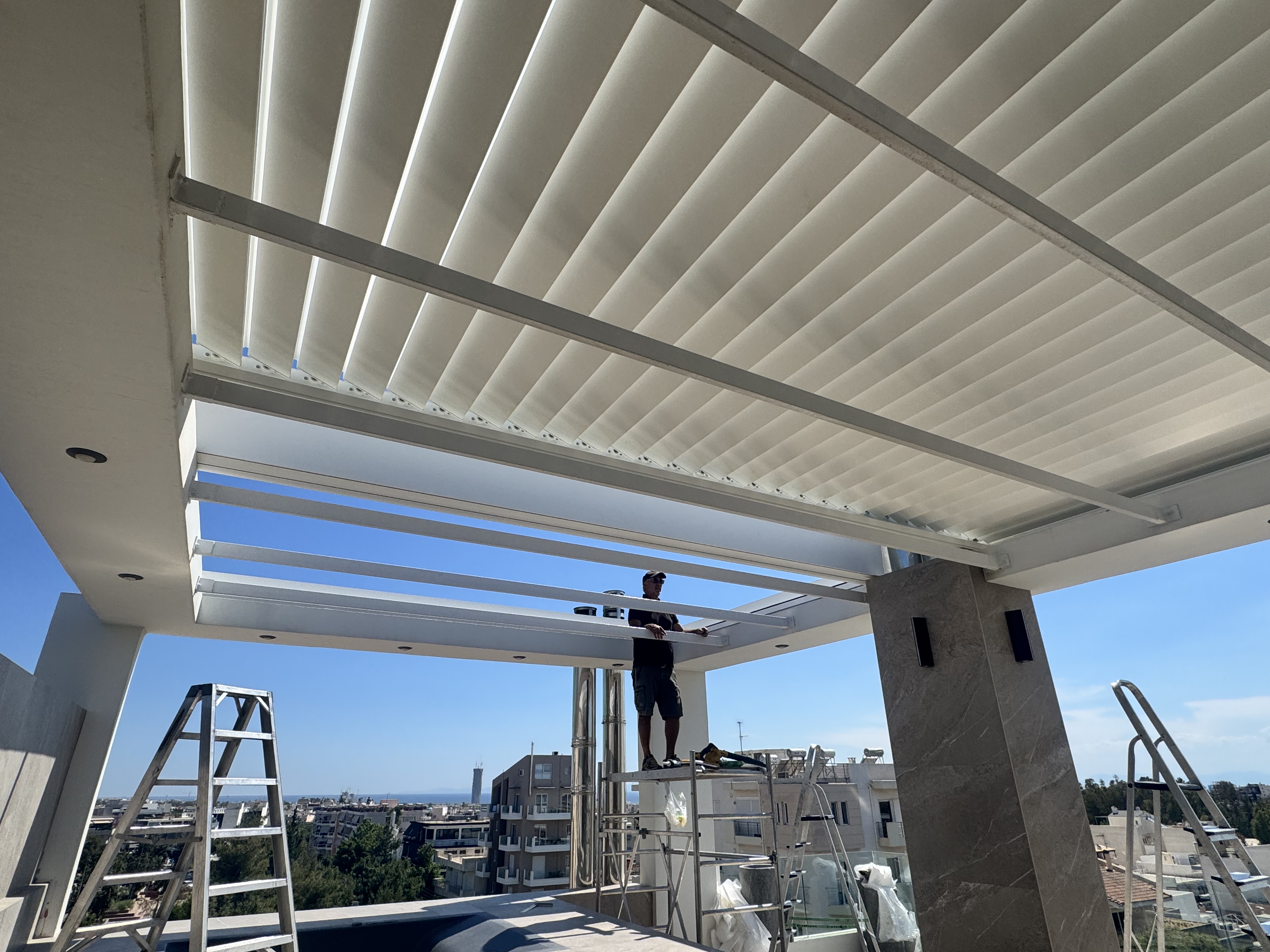
- Bioclimatic pergolas, with rotating aluminum louvres that open and close to control light and ventilation, represent the top tier — the engineering behind a watertight, motorized louvre system is considerably more complex than a fabric canopy.
If you're weighing these against each other, our guide to pergola awnings vs. bioclimatic pergolas goes into the practical differences in more depth. You can also browse the awnings, pergolas, and bioclimatic pergolas ranges directly.
3. Manual vs. Motorized, and How Much Automation You Add
A manual crank system is the cheapest way to operate any awning or pergola. Motorizing it — even with just a basic wall switch — adds cost, and each layer of automation on top adds more: a remote control, a wind sensor that retracts the fabric automatically in strong gusts, a sun sensor, rain detection, or full smart-home and app integration. These aren't just conveniences; a wind sensor in particular protects your investment by preventing storm damage, which is often worth the extra cost on its own. We cover the trade-offs in more detail in motorized vs. manual awnings. For a fully connected setup, take a look at our automation range.
4. Fabric and Material Quality
Not all fabric is priced the same. Acrylic solution-dyed fabrics tend to hold their color longest and resist fading; polyester options are typically more budget-friendly; PVC-coated and technical perforated fabrics — which can lower surface temperature by several degrees while preserving airflow and your view — sit at a higher price point because of the manufacturing process involved. The same logic applies to the frame: powder-coated aluminum, anodized finishes, and custom RAL colors all carry different costs. Our fabric buying guide and the fabrics range are good starting points if you want to compare options side by side.
5. Custom Shapes, Sizes, and Colors
Standard rectangular modules in standard sizes are the most cost-efficient option, because they use established manufacturing templates. The moment you move to a non-standard shape — a curved edge, a circular canopy, an asymmetric roofline to match an unusual balcony — you're paying for custom engineering, not just a bigger or smaller version of the same product. The same applies to fully custom colors outside a manufacturer's standard palette. It's not a reason to avoid a custom design — some of our favorite completed projects are custom circular and tensile structures built for a specific space — but it's worth knowing upfront that bespoke shapes cost more than modular ones. Our thoughts on choosing awning colors go into the aesthetic side of this decision, and our tensile structures range shows what's possible with fully custom shapes.
6. Add-Ons: Lighting, Heating, Screens & Glass Sides
Once the core structure is priced, most of the "extend the season" features are add-ons: integrated LED lighting for evening use, infrared heaters for cooler months, retractable wind and privacy screens, or sliding glass panels that turn an open pergola into a fully enclosed, weatherproof room. Each of these is optional, which is actually good news for your budget — you can install the core structure now and add features later as your needs (or budget) evolve. Take a look at our sliding glass panels range if a four-season room is the end goal.
7. Installation Complexity and Site Conditions
Two identical pergolas can cost noticeably different amounts to install depending on where they're going. A ground-floor patio with a solid concrete base and easy access is the simplest scenario. A rooftop terrace or high balcony may need additional structural reinforcement, more complex wind-load calculations, and cranes or hoists to get materials into place. Wall-mounted systems depend on what that wall is made of — reinforced concrete is straightforward, while older masonry may need extra anchoring work. Commercial installations — for a restaurant terrace, hotel pool deck, or café — often involve larger spans and stricter structural and safety requirements than a residential project. If that's your situation, our piece on shading for hospitality businesses and the commercial umbrellas range are worth a look.
8. Brand, Warranty, and After-Sales Support
The cheapest option on paper isn't always the cheapest option over ten years. Systems built with established European component manufacturers typically cost more upfront, but come with longer warranties, better spare-parts availability, and motors and mechanisms that are designed to be serviced rather than replaced. We go into why this matters in why it pays to invest in a well-built pergola or awning, and in repair or replace, which walks through how to judge whether an aging system is still worth maintaining.
Why We Don't Publish a Fixed Price List
You'll notice we haven't listed a single euro figure in this article, and that's deliberate. Generic price lists online are usually built around one "typical" configuration, and real installations rarely match it exactly — your wall, your roof structure, your wind exposure, and your local building requirements are all part of the actual cost, not just the product itself. A number that doesn't account for any of that isn't really a quote, it's a guess. What we can promise is that an on-site (or photo-based) assessment takes very little of your time and gives you a number you can actually rely on.
How to Get an Accurate Quote
You can speed up the process considerably by having a few things ready when you contact us:
- Rough measurements of the space (even approximate ones help).
- A few photos of the wall, roof, or balcony where the system would be installed.
- What problem you're solving — more sun protection, rain coverage, privacy, evening use, or a fully enclosed extra room.
- Any must-haves: motorization, specific colors, matching an existing structure, and so on.
- A rough budget range, so we can recommend options that actually fit it.
From there, we'll recommend a short list of realistic options and give you a firm, itemized price — not a vague range.
Frequently Asked Questions About Shading System Pricing
Is a pergola cheaper than an awning?
Usually not — a standalone retractable awning is typically the more affordable option, since it doesn't require a full structural frame. A pergola or pergola awning costs more but gives you a permanent structure that can carry lighting, heating, and glass sides if you want to extend it later.
Do bioclimatic pergolas cost more to run, not just to buy?
The motor and controls use very little electricity — comparable to any small household appliance used occasionally. The bigger ongoing cost consideration is maintenance of the louvre mechanism and seals, which is why we recommend sticking with established manufacturers and a proper maintenance plan.
Does adding a shading system increase property value?
A well-built, well-maintained outdoor structure is generally seen as a genuine improvement to usable living space, which is typically viewed favorably compared to a bare, unshaded patio or balcony — particularly for properties that rely on outdoor space for part of the year. It shouldn't be the only reason to invest in one, but it's a reasonable secondary benefit.
How much does maintenance cost after installation?
For most systems, ongoing maintenance is minimal — periodic fabric cleaning and a mechanism check. We cover the basics in our shading care guide. Ask us about maintenance plans when we quote your installation.
Ready for a Price Tailored to Your Space?
Every space is different, and the only way to get a number you can actually plan around is a real assessment of yours. Get in touch and we'll walk you through your options, explain exactly where your budget is going, and put together a clear, itemized quote — no pressure, and no generic price list.
Want to learn more?
Since 1974, we've designed and built custom shading solutions. Contact us for a free assessment.
Request a Quote